
From a Milanese workshop in 1929 to a timeless voice of Italian design.
Hello everyone.
I am a brand.
And this is my story.
I was not always a brand.
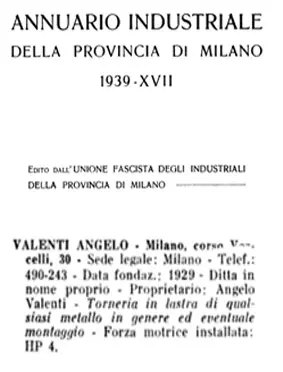
At the beginning, I was only a name — the name of my founder, Angelo Valenti.
1929 — The Beginning
The year was 1929, a year that history would remember as the beginning of a global crisis.
Italy was living through the Fascist era, and Milan — the beating heart of industry and craftsmanship — tried to move forward in a climate of control and uncertainty.
On October 24th, the crash of the New York Stock Exchange shook the world economy, triggering what would later be called the Great Depression.
And yet, in that fragile and difficult time, Angelo Valenti and Maria Radice decided to build their future.
Maria came from an old family of blacksmiths: she carried in her blood the strength of metal and the pride of skilled hands.
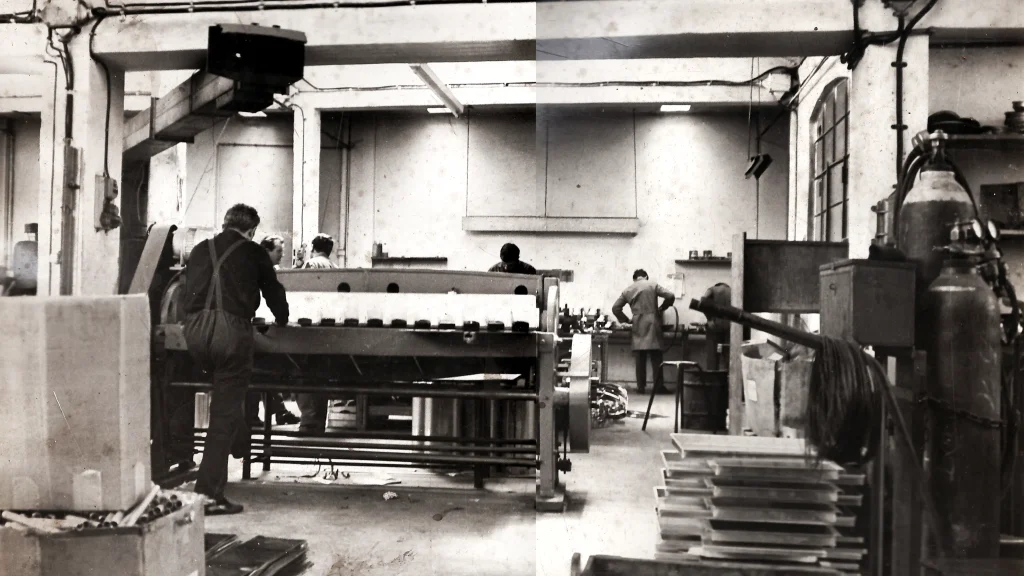
Together, with courage and vision, they founded a small workshop in Piazza Wagner, in the heart of Milan, specializing in metalworking for the mechanical industry.

It was a living, resonant place — sparks flying, steel bending under hammers and early industrial lathes.
In those years of uncertainty, the company survived thanks to determination, precision, and the ability to turn raw material into possibility.

In 1937, Maria’s son, Renzo Pighi, a seven-year-old boy, began spending time in the workshop.
He watched the artisans at work, fascinated by the heat of the furnaces, the smell of iron, the rhythm of machinery.
Mechanics drew him in — not as noise, but as language.
Angelo, though not his biological father, became a model of discipline and integrity.
In 1940, Italy entered the war.
Industries were converted, materials rationed, production driven by necessity.
The small workshop did not stop, but adapted to survive.
Then, in 1945, the war came to an end.
Milan was a wounded city — buildings collapsed, factories destroyed — yet filled with the will to rebuild.
Those who lived through that time remembered the same feeling: a collective hunger for life.
Renzo, now a young man, devoted himself entirely to his craft.
He became a master of metal spinning, an art that requires sensitivity, control, and patience.
While Italy began to rise again, he was already shaping the foundations of something new — a skill that would one day become the language of light.
1946 — A New Milan
The year 1946 marked a turning point for Milan.
The city was rebuilding both physically and culturally; architects and artists were redefining modernity.
The magazine Casabella (no.194, 1946) published the AR Plan by Franco Albini and Ernesto Nathan Rogers, a manifesto for urban rebirth.
A year later, the 8th Triennale of Milan introduced a visionary project for an experimental residential district: the future QT8, built using the rubble of the bombings.
In 1948, Lucio Fontana and others signed the First Manifesto of Spatialism, opening a new era in the way we understood space, matter, and light.
And in 1949, Milan’s official Reconstruction Plan was approved — a symbol of rebirth and energy.
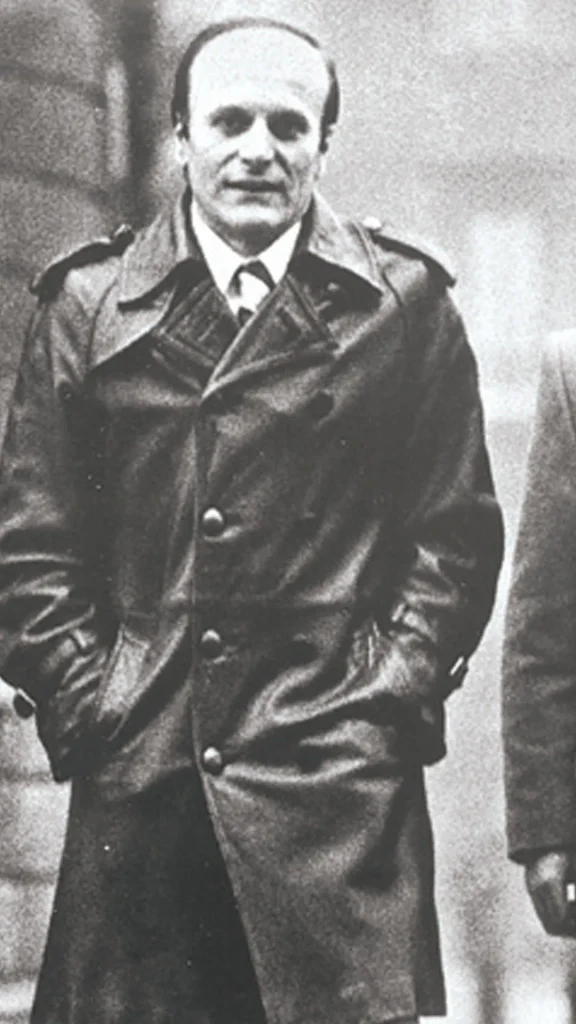
Amid this renewal, Renzo Pighi continued to refine his art.
The Piazza Wagner workshop had become a reference point for precision metalwork.
Craftsmanship evolved into method; the hand became thought.
Renzo realized that mechanics could turn into design, and that a craftsman’s gesture could dialogue with an architect’s vision.
In 1956, the ADI – Associazione per il Disegno Industriale (Association for Industrial Design) was founded in Milan, marking a decisive moment in the development of Italian design culture.
It was in this context that Valenti began to specialize in lighting design, transforming technical expertise into a new field of production.
They were difficult but magical years.
Italy entered its “economic miracle”, and Milan became the capital of modern design.
Factories became laboratories of ideas, and light became a symbol of modernity.
Renzo Pighi understood that the future belonged to those who could merge technique and imagination.
Valenti worked as a subcontractor for some of the companies that were shaping the new Italian design industry, including Artemide, founded by Ernesto Gismondi, and Kartell, founded by Giulio Castelli. The workshop developed prototypes and manufactured early production pieces, putting its technical knowledge and mastery of metal at the service of a new generation of designers and entrepreneurs.
Among these collaborations was the initial production of Eclisse for Artemide, designed by Vico Magistretti.
Renzo later recalled that, drawing on his experience as a skilled technician and metalworker, he had suggested a simple and economical technical solution for the mechanism that allowed the inner shade to rotate. It was a memory he remained proud of throughout his life — part of the workshop culture in which designers, entrepreneurs and craftsmen worked closely together to transform an idea into an industrial product.
Working as a subcontractor meant understanding industry logic, but it also meant remaining behind someone else’s name.
Renzo wanted more.
1965–1968 — From Ecolight to Valenti
Around 1965, Valenti began developing its own lighting production.
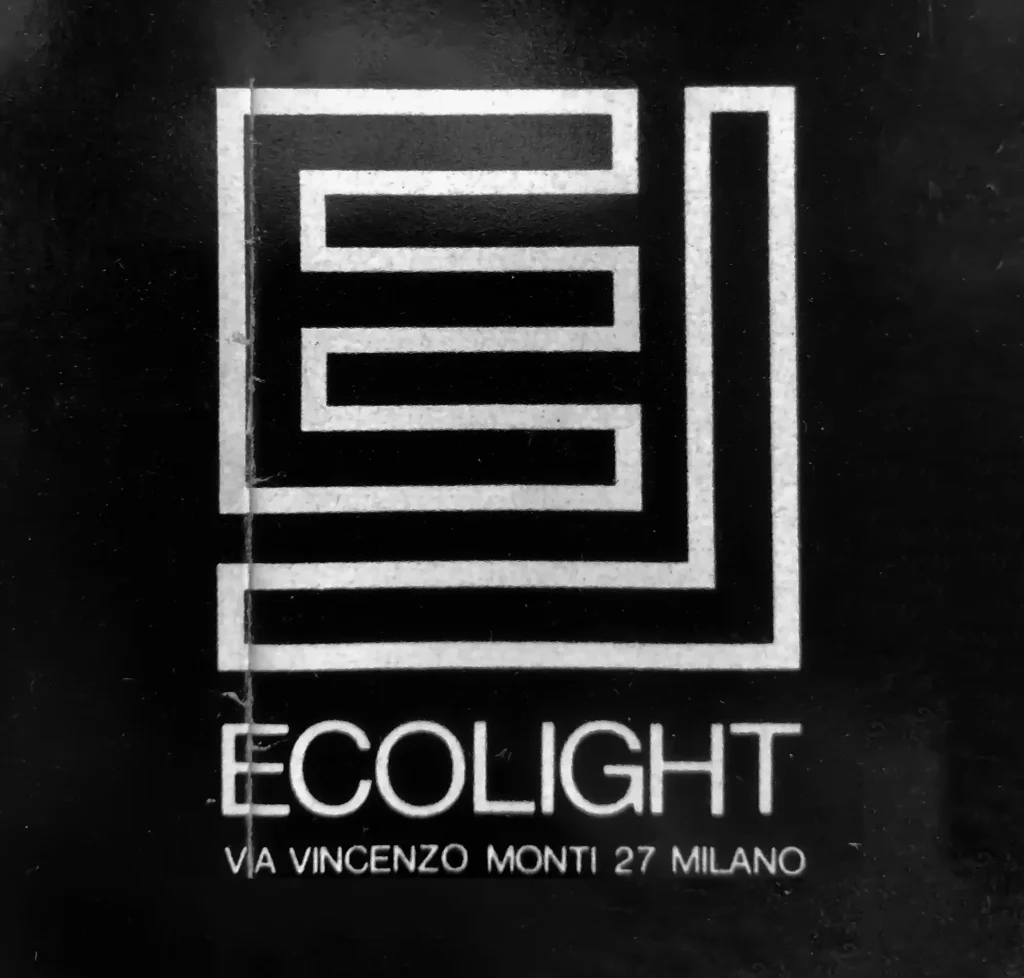
The name Ecolight was introduced for this new activity: a division of Valenti that allowed the company to approach the lighting market with its own products while maintaining a distinction from its established role as a subcontractor.
This was a delicate transition.
The companies for which Valenti had long manufactured products did not necessarily welcome the idea of their supplier entering the market directly.
Ecolight offered a way forward — a separate identity under which Valenti could begin to experiment with its own commercial presence.
It would be a short but important chapter.
In 1966, something new — and final — happened.
I was born.
Valenti.
The new name also began to take visual form. An advertising poster designed by Pino Tovaglia featured an early version of the Valenti logo.
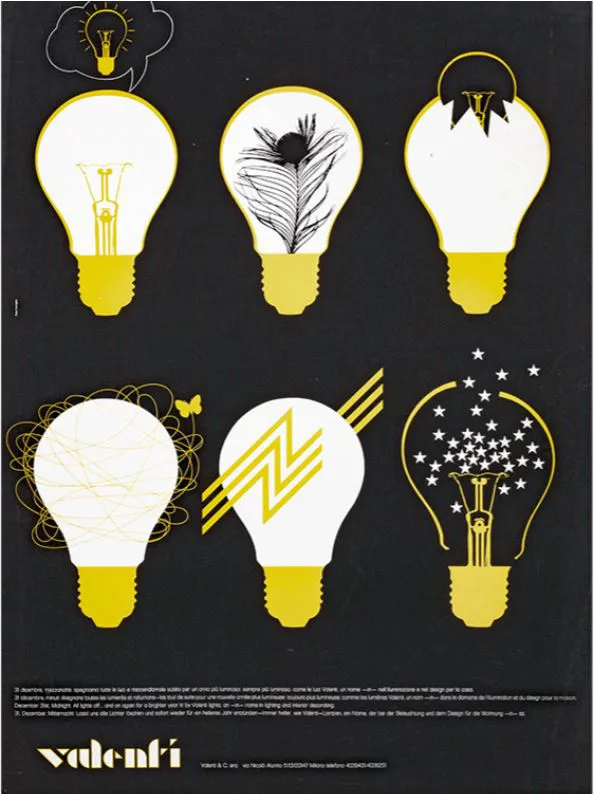
The family name became the identity of the company’s own production.
No longer a hidden name behind another’s project, I became an identity.
A voice meant to express light as a form of culture, material, and emotion.
Milan was alive with innovation.
Architects met with manufacturers, designers searched for new materials and expressive freedom.
Renzo, with his artisanal intelligence and industrial sensibility, gathered around him a group of young minds capable of imagining a different future.
In 1967, he met architect Luciano Patetta, professor at the Politecnico di Milano.
From their collaboration came Diatomea, a table lamp composed of an upper shell and an inner methacrylate diffuser — a perfect balance of sculpture and function, where light built its own form.
That was the beginning of a golden age.
With perseverance and passion, Renzo assembled a group of young designers and entrusted them with the artistic direction of the company: Isao Hosoe, Olaf von Bohr, Ezio Didone, and Studio Tetrarch.
From their work emerged objects of freedom, vision, and originality — pieces that did not follow the market, but anticipated it.
In those same years, Emira and Guido Fochi designed Mysia, another expression of Valenti’s early exploration of light, material and form.
Renzo printed a small catalogue, in black and white, showing the first models.
He personally travelled across Italy and Europe, bringing with him lamps that looked like nothing else on the market.
It was not easy. The established brands were wary of this new Milanese voice.
But my difference became my strength.
In 1968, young Austrian designer Olaf von Bohr designed Medusa, a lamp that celebrated a myth of classical Greece.
Twenty-eight painted aluminum strips, bent by hand to create a sinuous, luminous form.
A perfect meeting of minimal geometry and poetic movement.
But my story is not only about lamps.
In 1968, relying on our deep knowledge of metal, we designed a coat stand for a Swiss office furniture manufacturer — a simple yet sophisticated structure defined by its clarity of form.
The product was an immediate success: it spread quickly across German-speaking Europe.
Dozens of institutions, banks, and companies chose to hang their coats and place their umbrellas on Valenti coat stands.
A humble object, yet one that expressed order, elegance, and durability.
Soon after came collections of everyday objects — ashtrays, trays, coasters, table accessories — all conceived with the same philosophy: that even the simplest gesture could hold the dignity of design.
During these years, the distinction between Ecolight and Valenti gradually disappeared.
What had begun as a way to enter the lighting market independently had fulfilled its purpose.
After only a few years, Ecolight gave way to a single identity.
Valenti.
Independent. Recognizable. Free.
My birth was not a spark — it was an explosion of light, creativity, and courage.
From Milan, from the hands of a craftsman and the minds of a generation, I came to life to enter the history of Italian design.
1969–1970 — Pistillo
The new decade opened with extraordinary creative energy.
In 1969, Studio Tetrarch — Bonati, Bonatti, De Munari, and Federspiel — sought to move beyond Murano glass and explore plastic, the new material of modernity.
The result was Pistillo (1970): a silvery flower of light, radiating from a central core.
It became a symbol of my identity — a lamp that was also a sculpture, uniting technique and wonder.
As Carlo De Munari recalled:
“It began as a modern interpretation of the Murano glass chandelier. The attempt failed — but plastic, at that moment, seemed arrogantly capable of solving every problem, replacing every other material.”
That same year, Olaf von Bohr continued his collaboration with Valenti with Airone, while Gaetano Scolari designed Home / Professional.
The collection was growing, but more importantly, so was the number of different voices contributing to it.
1972 — A Year of Extraordinary Creativity
Then came 1972.
It was one of the most prolific years in my history.
Around Renzo Pighi, designers with very different backgrounds and sensibilities were given the freedom to experiment with form, materials and new ways of shaping light.
Almost at the same time, Isao Hosoe, young and ambitious, created Hebi — a flexible tube covered in corrugated plastic, with a painted metal diffuser at one end.
The first version had a spherical base, later replaced by a clamp and wall mount.
Simple. Ingenious. Universal.
From 1972, Hebi was produced in several colours and sold worldwide.
But Hebi was only one expression of an extraordinarily creative year.
Studio Tetrarch returned with Pistillino and Foglia.
Pistillino took the unmistakable language of Pistillo and transformed it into a smaller, independent object, suitable for table, wall and ceiling use.
Olaf von Bohr explored new forms with Conchiglia, Dafne, Faro and Studio.
Isao Hosoe also designed Tama.
Ezio Didone created Squadra, Filippo Panseca contributed Zero, while Luigi Padova and P. Bocci designed Anemone and Alice.
The 1972 catalogues document twelve new models — an extraordinary concentration of ideas in a single year.
But numbers alone do not tell the story.
What mattered was the diversity.
There was no single Valenti style imposed on every designer. Instead, there was a shared attitude: curiosity, experimentation and the willingness to turn an idea into an object that could actually be made.
Renzo’s knowledge of materials and production made this possible.
The workshop that had begun in Piazza Wagner more than forty years earlier had become something very different: a place where craftsmanship, industry and design could meet.
1973–1975 — A Growing Collection
In the years that followed, the collection continued to evolve.
In 1973 came Bigo and Sfera.
By 1975, another group of objects and designers had joined the Valenti story: Franco Mirenzi with Saba, Zeta Tavolo and Vaga; Gianfranco Pasotto with Alobella; Olaf von Bohr with Atollo; and Salvatore Gregorietti with Tricit.
And in that same year came Alina, designed within Valenti.
By then, I was no longer trying to find my place in the world of Italian lighting.
I had found it.
to be continued…